
Current Enthusiasms #35: talking to myself
Earnest recommendations.
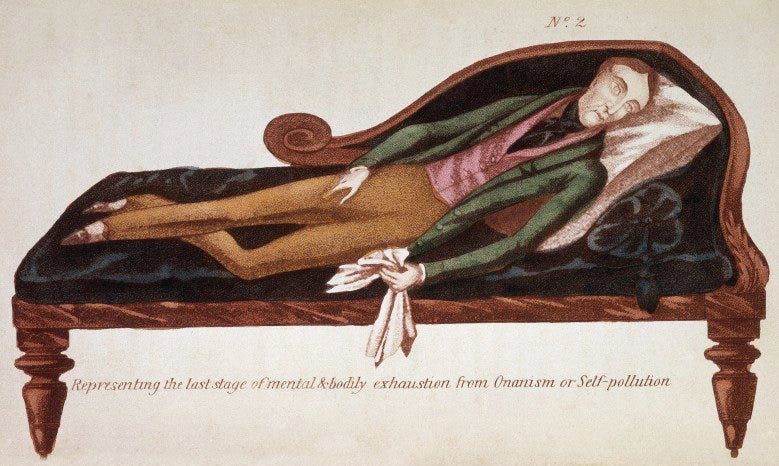
“Representing the last stage of mental and bodily exhaustion from Onanism or Self-pollution”, engraving from The Secret Companion, a Medical Work on Onanism (1845). I’m not going to spell it out for you here but this image struck me as apt.
I am writing a book, and when I write a book, I talk to myself. I’m not being poetic, suggesting that the text is a missive to myself (it most decidedly is not!) but literal: I talk, out loud, to no one, well, to myself, I guess. The man with whom I share an office as well as a life can corroborate this. Lately, I’ve been thinking out loud quite a bit. I’m not sure what this says about the book I’m working on. Almost done, or not even close; better than usual, or my worst work yet.
The other night I read a profile of the novelist Richard Powers in a two year old issue of The New Yorker that I have been saving specifically to read this article, in which the writer is described as (in part) “dictating” his work. I seem to remember reading this about Powers in another profile, perhaps in the Times Magazine, and both times I have learned this about Richard Powers it has made me feel better about myself. He’s a better writer than I am, but we have this in common: when I’m writing a book, I’m talking.
When I have completed a full draft of a book, I read it aloud to myself. This is common practice, I think; lots of writers advise this, or I almost certainly came to adopt this tactic because someone told me to. I do think it’s effective: I can revise the same sentence ten times and then hear it out loud, in context, and understand immediately what’s wrong with it, or what I want it to be.
But that’s not quite what I’m referring to. I am not in the read the full draft aloud to yourself stage. I’m at the stage where I read the thing, mark it up, sit down to make those changes, get carried away and do more cutting and rewriting than my handwritten notes indicate. (It’s because these snowball; you cut one bit in the second section, and the third section now requires further explanation, thus, so many necessary changes not reflected in the stuff I write on the manuscript.) It’s not a logical process.
I suspect the development of truly effective noise-cancelling headphones has something to do with this phenomenon of talking aloud. The music in my ear as I work (I listen to the same things over and over, cannot, it seems, accept novelty when it comes to the music I listen to when writing a book) makes my literal voice seem as remote as my inner voice. Or I confuse the two. When I have Alexandre Desplat’s moody soundtrack to Jonathan Glazer’s Birth (I listen to this every workday) blasting in my ears, I don’t know if I’m thinking or talking.
Or maybe I’m emboldened in middle age and can now embrace this tactic I find helpful. I’m fortunate to have a room of my own in which to work. If I have to talk something out when I’m writing, there’s no one around to hear, except sometimes my husband, and he’s surely used to this. So I talk, as I revise, as I write, trying out the sentences, feeling my way toward a specific word. This talking isn’t confined to that room of my own; I’m at that point where I’m thinking about this book all the time, like an unrequited crush, and sometimes I talk in the shower, trying out sentences I might write when I’m dry and have a pencil at hand.
I joke often about how writing a novel is similar to mental illness: a preoccupation with imagined people and events, a sense that the narrative in your brain is apart from and more significant than reality. I suppose we imagine unwell people talking to nonexistent voices, which isn’t quite what I’m doing, though it would certainly look like that to someone who didn’t know I was not “insane” but “a novelist.”
I slip, sometimes, and talk to myself when I’m in public. I went to see some art recently and I found myself talking to myself twice. Once I said, simply, “Alice Neel,” like I had spotted the woman, alive, after a long absence from my life, like I had recognized her and was excited. Oh, hey, Alice. Cool. Later, I said something like “What a funny sicko.” I was talking about Eric Fischl. To myself, I guess. There was no one in the gallery with me, at least.
I was discussing with another writer, recently, a theory that I have been kicking around, that a work of art—in this case, a novel—contains a trace of the mood in which it was created. I think if you’re having fun while you make something, some echo of that enjoyment remains in the finished product. What do I know. Do I recommend talking aloud? Maybe it is a symptom of not caring too much about things, which I do endorse. Sure. Why not? Talk to yourself.
Work is work, not fun, but I am having fun with this book, lately, and I think the talking out loud is a symptom of that. It’s not only that I’m listening to Mitski too loud; it’s not that I’m undergoing psychic break. It’s that I’m enjoying making the words concrete and spoken months or years before they become fixed on the page of a printed book, something to be read, but not read aloud, unless you’re an audiobook performer or reading a book to a child, though I don’t think the book I’m writing should be read to any children. What a funny sicko applies to me as much as it does Eric Fischl, or at least, that’s my hope.
*
This summer, I’m leading a virtual workshop. It’s courtesy of my pal Lynn Steger Strong. I’ve not taught since last Spring, about this time, and I miss it. The first link has more info on the class structure and how to apply.
*
Current Enthusiasms is a newsletter about things I like. I’ll send it every two weeks.
Co-signed. Talking to myself is a HUGE part of my process when I go away to write. I must look demented!