
Current Enthusiasms #39: the end of Henderson the Rain King
Earnest recommendations.
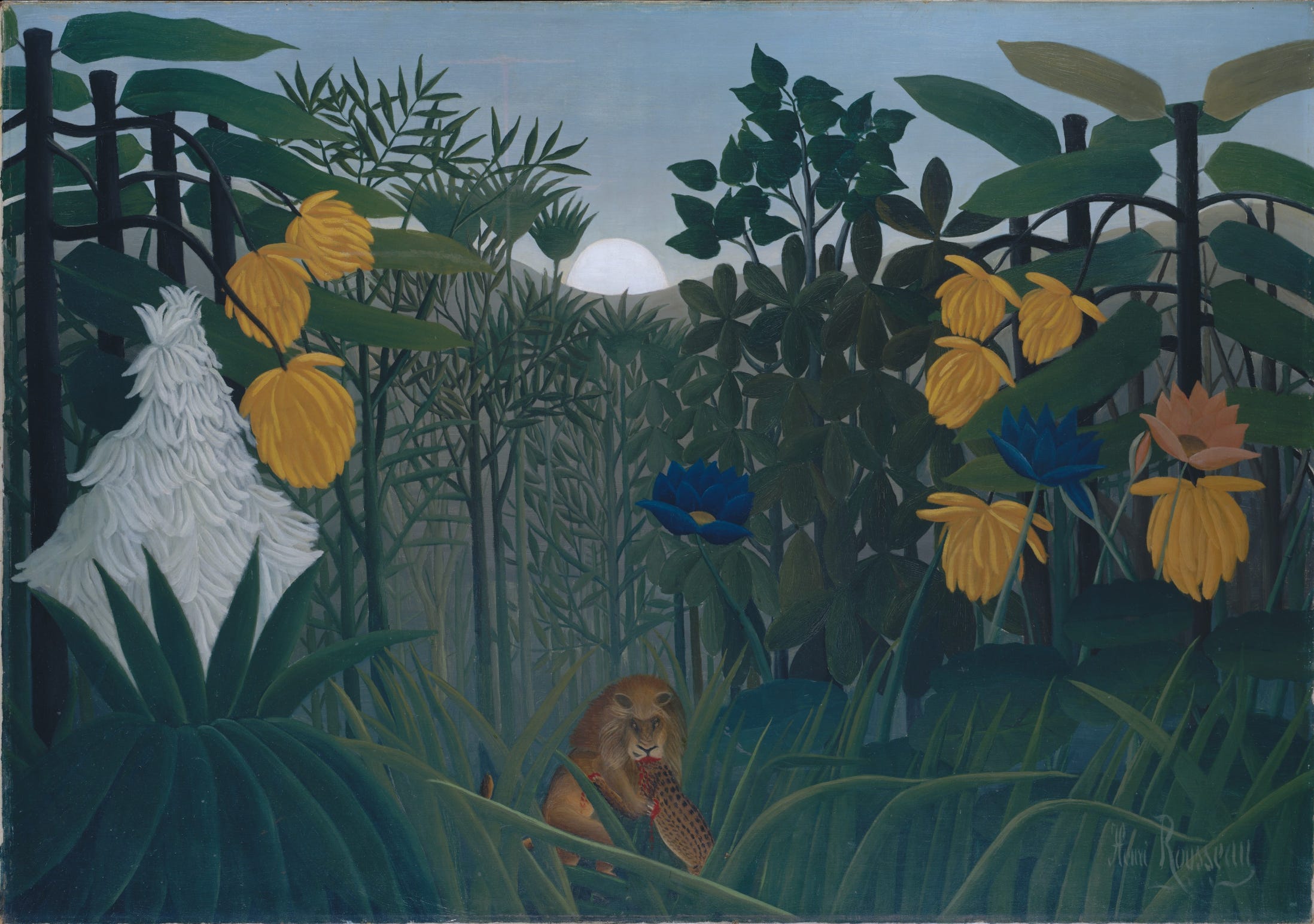
Henri Rousseau, The Repast of the Lion, ca. 1907. You can visit this painting if you’re in New York! I’m kind of snobbish about Rousseau because I consider him somehow tangential to surrealism, which I cannot abide, but the truth is when I see his paintings in person I am always charmed.
Thus far in 2026 I’ve read 78 books, 77 of which were new to me, the outlier being Saul Bellow’s Henderson the Rain King. I’m generally reluctant to reread a book. If I didn’t like it the first time, why bother, and if I loved it, there’s the risk of disappointment if it doesn’t hold up. Never mind that there’s a finite number of books to fit in over a lifetime. That I’ll die barely having scratched the surface seems so unfair.
I first read Bellow in 2015: Humboldt’s Gift, which I often cite as a favorite, though I suspect its being my first exposure to Bellow’s magic has something to do with that. No one writes like Bellow. There’s music in his prose and none of the many of whom I might say the same (Norman Rush, Lorrie Moore, William Faulkner, Maxine Hong Kingston) is singing quite the same song. I find it lazy when people invoke genius, but with Bellow I think the term applies and honestly I’m not sure what else there is to say.
Between 2015 and 2018, I read most of Bellow’s ouevre, including The Adventures of Augie March, another book I designate a favorite. Why I chose to reread Henderson instead of those ostensible faves had something to do with the presence of a lion in the story, and something to do with the fact that a picaresque is the closest I can get to travel right now. It was an impulse.
Henderson is weirder than I remembered, yet somehow straightforward: Henderson, a millionaire pig farmer and amateur violinist, has a void within, manifest as an inner voice repeating I want. He decides to go to Africa and see if he can’t meet that undefined desire. Sure, why not. He meddles—he’s an American!—in the affairs of a tribe called the Arnewi. Trying to rid the village cistern of a plague of frogs, he blows the whole thing up. It’s funny, I promise. There’s a feat of strength, there’s a lion hunt, there are many philosophical conversations with a king, there’s a long trip back to the United States. It’s a masterpiece.
Likely you know that the author hadn’t visited the African continent when he wrote this novel. These days, we call that problematic but to me, Henderson is so purely a fiction, its Africa clearly not a real place, its characters barely people, that I can’t feel indignant. Bellow’s Africa doesn’t feel reductive but imagined, a stand-in for something spiritual or philosophical, a state of mind more than geography. Anyway, the choice is either to try to understand art from a benighted past or to ignore it altogether. Up to you!
Spoilers ahead but here’s what happens at the end of this book, a couple of pages that I can’t stop thinking about. Henderson, with a lion cub in tow, shows up at the American consul in Khartoum. They want to get rid of this lunatic, so he flies on to Cairo. From there, he goes to Athens, walks the lion on a leash near the Acropolis. Then he goes to Rome. “I bought a corduroy outfit, burgundy colored, and an alpine hat with Bersagliere feathers, plus a shirt and underpants.” Then he flies to Paris, and thence to London before heading for Idlewild.
Henderson can’t understand how his fellow passengers are reading.
How can you sit in a plane and be so indifferent? Of course, they weren’t coming from mid-Africa like me; they weren’t discontinuous with civilization. They arose from Paris and London into the skies with their books. But I, Henderson, with my glowering face, with corduroy and Bersagliere feathers—the helmet was inside the wicker basket with the cub, as I figured he needed a familiar object to calm him on this novel, exciting trip—I couldn’t get enough of the water, and of these upside-down sierras of the Clouds. Like courts of eternal heaven.
Joni Mitchell has said that a different description of clouds glimpsed from an airplane window, from earlier in the novel, inspired her to write “Both Sides Now.” So take that! One of the other passengers is an orphan, being sent to live with his American grandparents in Nevada. The kid speaks only Persian (we say Farsi now) and a flight attendant, taking pity on him, tells Henderson that the lion cub might cheer the boy.
He was very white and wore short pants with strap garters and a little dark green sweater. He was a black-haired boy, like my own. This kid went to my heart. You know how it is when your heart drops. Like a fall-bruised apple in the cold morning of autumn.
The lion cub indeed cheers the kid; even I, who hate cats, would probably enjoy playing with a baby lion. Henderson feeds the boy dinner, and the child falls asleep on his lap. When the plane lands in Newfoundland to refuel, Henderson and this child get out for some air. Here are the final lines of the book:
Laps and laps I galloped around the shining and riveted body of the plane, behind the fuel trucks. Dark faces were looking from within. The great, beautiful propellers were still, all four of them. I guess I felt it was my turn now to move, and so went running—leaping, leaping, pounding, and tingling over the pure white lining of the gray Arctic silence.
The ending of this book strikes me as the most exhilarating thing I’ve read in a long while. It’s beautiful, technically, that repetition of “leaping”; it’s lovely as an image, a man carrying a young boy and running around an airplane, its four propellers stilled. You can hear Henderson’s voice in the few sections I’ve quoted here so you understand that it’s striking that so loquacious a narrator ends his story marveling at silence.
Sometimes you read the right book at the ideal moment. I’ve been yearning for surprise. It’s there, in Bellow’s music, inimitable as far as I’m concerned. It’s in the story’s conclusion, which brushes against joy without being insipid. Henderson seduced me, baffled me, perhaps even offended me (Africa is “discontinuous with civilization”?), then reminded me that even with respect to a book you’ve read before, you never know how a story is going to end.
*
Current Enthusiasms is a newsletter about things I like. I’ll send it every two weeks.
Bellow is such a strange bird. I gave up on this book shortly after Henderson blew up the pool and visited the king, but I love Augie March and Seize the Day and The Victim without reserve. Maybe I’ll return to this one and Herzog some day, I always love the quoted passages but don’t like the books as a whole.
It’s heartening that you love Bellow. Thank you for this.